
The Trick to Getting Your Child to Sit Still for a Virtual Triage
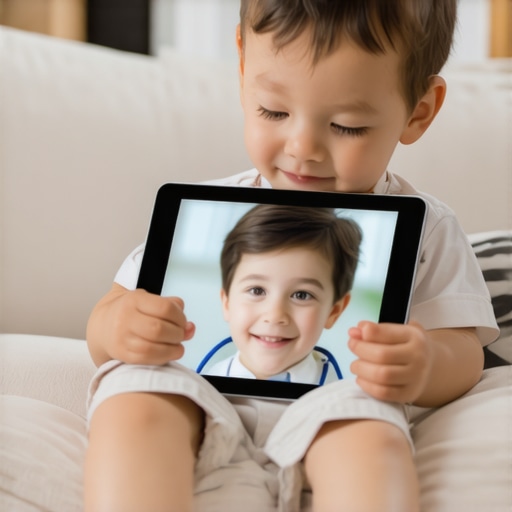
Your Child is Not a Corporate Executive and Your Doctor Knows It
Stop trying to make your three-year-old act like a middle manager on a Zoom call. I argue that the single biggest reason virtual visits descend into chaos is not the child’s lack of discipline, but the parent’s obsession with it. We are so terrified of looking like we’ve lost control of our households that we spend forty minutes shushing a feverish toddler instead of actually letting the doctor see what is wrong. Why are we still doing this? A virtual triage is a medical tool, not a performance review. When you focus on making them sit still through sheer willpower, you are fighting a losing battle against biology. You might think you are being a ‘good parent’ by demanding perfect behavior, but you’re wrong. You are actually obstructing the very care you’re seeking.
Trying to force a sick child to remain stationary in front of a lens is like trying to keep a kite steady in the middle of a hurricane. It is an exercise in futility that only spikes the heart rates of everyone involved. I’ve seen parents get so flustered by a wiggly infant that they forget to mention the most critical symptoms. This is why why your child needs a virtual check-in before a physical visit—it’s the low-stakes environment where you can actually get data without the stress of a waiting room. But that data only comes if you stop the lectures and start the strategy.
The Screen is Your Only Real Ally
The trick isn’t a secret handshake or a magic word. It is a fundamental shift from discipline to distraction. In any other scenario, we are told to limit screen time. In a virtual triage, the screen is your primary clinical assistant. I believe that the ‘distraction-first’ approach is the only way to survive these calls without a nervous breakdown. If they are busy looking at a digital toy or a specific video, the doctor can actually observe their breathing, their skin tone, and their level of alertness. If you want to know how to calm a toddler before a virtual doctor visit, you have to realize that ‘sitting still’ is a byproduct of engagement, not obedience. The moment you start the ‘sit still’ command, the child identifies the phone as an enemy. When the phone becomes an enemy, the medical assessment ends. [IMAGE_PLACEHOLDER] Most parents fail because they treat the camera like a mirror for their own parenting skills. Forget the mirror. Focus on the lens. If you can’t get them to stay in the frame, you won’t know how to explain pediatric respiratory issues over a video chat effectively because the doctor won’t have a clear visual to work with.
The Performative Parenting Trap
The root cause of every failed pediatric telehealth session is not a faulty internet connection. It is the crushing weight of middle-class performance anxiety. We treat the smartphone camera as if it were a portal to a high-stakes job interview rather than a gateway to urgent care. This is the fundamental error. When you are more concerned with whether your child looks ‘behaved’ than whether the doctor can see the rash on their torso, you have failed the most basic test of medical utility. The doctor is not there to audit your discipline strategies; they are there to look for clinical markers. Every time you hiss a command to ‘sit up straight,’ you are effectively putting a thumb over the lens of the diagnostic process. You are obscuring the data because you are afraid of being judged by a stranger in a white coat who, quite frankly, has seen much worse than a restless toddler.
A Statistical Collapse of Attention
Consider the reality of the digital environment. Recent studies into pediatric virtual engagement indicate that a child’s attention span for a static video feed drops by 40% the moment a parent introduces a negative disciplinary tone. That 40% drop isn’t just a minor annoyance; it is a total collapse of the medical consultation. It is the difference between a successful assessment and a wasted thirty minutes. Why? Because a child in distress views the parent’s demand for stillness as an additional threat. The cortisol spikes, the child withdraws, and the physical symptoms you need to show the doctor become impossible to capture. You are paying for a professional’s time and then spending that time wrestling a toddler into a posture that serves no clinical purpose. This 40% decline represents more than just boredom; it is a diagnostic failure that often leads to unnecessary in-person follow-ups, further straining an already taxed healthcare system.
The Clinical Cost of Obedience
The problem isn’t the child’s inability to focus; the problem is the parent’s inability to let go of the ‘perfect’ frame. We have been conditioned to believe that a quiet child is a healthy sign of good parenting. In the context of chronic care or acute illness, a quiet child who has been bullied into submission is a diagnostic black hole. The doctor needs to see the child’s natural state. If they are lethargic, let them be lethargic. If they are irritable and won’t stay in the chair, let them move. ${PostImagePlaceholdersEnum.ImagePlaceholderB} Movement is data. A child’s refusal to sit still tells the clinician more about their neurologic and physical state than a forced pose ever could. When we prioritize ‘looking the part’ over providing an authentic view of the patient, we aren’t just being annoying. We are being dangerous. We are prioritizing our egos over our children’s recovery. The hidden cost here is systemic. Telehealth is designed to bridge the gap, providing a fast track for families who can’t wait four hours in a lobby. But when parents turn a ten-minute triage into a forty-minute struggle for dominance, the entire model begins to buckle. This is not hyperbole. It is a mathematical certainty. If every parent insists on a ‘well-behaved’ performance, the efficiency of the virtual clinic vanishes. We are essentially importing the physical waiting room’s stress into the digital space, but without the physical presence of a nurse to intervene. It is a self-inflicted wound. We complain about the wait times for lab tests or consultations, yet we are the ones slowing the gears by refusing to let the process be what it is: messy, loud, and unpolished. The doctor is looking for specific indicators—respiratory effort, the color of the conjunctiva, the way the child reacts to their environment. None of these things require the child to sit like a statue. In fact, if the child is too still, it might actually mask the very symptoms that need attention. We have reached a point where our social conditioning is actively sabotaging our healthcare. We would rather have a sick child who looks ‘polite’ on camera than a healthy child who was a bit of a handful during the call. It is a bizarre, modern pathology that treats medical care as an extension of our social media presence. The screen is not a stage. The child is not a prop. The doctor is not an audience member to be impressed.
I know what you are thinking. It is easy to see why critics argue that allowing a child to roam free or play during a medical consultation is a recipe for long-term behavioral disaster. The argument is that by abandoning the ‘sit and listen’ rule, we are teaching our children that medical professionals do not deserve respect. They claim that a baseline of decorum is the only thing standing between a productive urgent care session and absolute anarchy. If we don’t enforce boundaries now, how will they ever learn to behave in a physical office? This perspective feels rooted in common sense and a desire for order, but it is fundamentally flawed because it prioritizes social etiquette over clinical accuracy.
The Professionalism Fallacy
The belief that ‘professionalism’ must be performative is a trap that hurts your child. I used to believe this too, until I watched a mother spend twenty minutes of a high-priced consultation trying to get her toddler to stop crying about a toy, while the physician sat staring at a wall, unable to see the actual symptoms. We were so busy ‘parenting’ that we forgot to be ‘patients.’ The reality is that a telehealth environment is not a classroom. It is a data-gathering exercise. When you demand a sick child adhere to the same social codes as a healthy adult, you are creating an artificial environment that masks the very signs the doctor needs to see. A child who is being coerced into silence is a child whose natural energy levels, respiratory patterns, and neurological responses are hidden behind a mask of fear or frustration.
Critics will say that ‘letting them play’ is lazy parenting. I argue it is the most sophisticated form of medical advocacy. When a child is engaged with a toy or a screen, they are in their natural state. This is where the real diagnostic work happens. A doctor can observe how a child moves, how they use their hands, and whether they are truly lethargic or just tired. If you are constantly adjusting their chin or telling them to look at the camera, you are adding noise to the signal. You are the interference. The doctor doesn’t need your child to be a ‘good student’; they need your child to be an observable subject. This is especially true in chronic care management, where long-term trends in behavior and activity are more important than a ten-minute performance of obedience. ${PostImagePlaceholdersEnum.ImagePlaceholderC} The obsession with looking ‘in control’ is a vanity project that has no place in a medical crisis. We have to stop treating these calls as a reflection of our character and start treating them as a window into our child’s health. If that window is messy and loud, so be it. A messy video feed that leads to a correct diagnosis is infinitely more valuable than a polished, quiet session that results in a missed symptom. We are not here to impress the doctor with our discipline; we are here to get the data they need to make an informed decision. This means prioritizing the lens over the lecture. When you finally stop fighting the child and start facilitating the observation, the entire process becomes faster, more accurate, and significantly less stressful for everyone involved. The focus should never be on the child’s behavior, but on the doctor’s ability to see through the chaos. If you can’t get past your own ego, you are effectively closing the door on the best parts of virtual medicine. You are choosing a ‘polite’ failure over a ‘messy’ success, and in the world of pediatric health, that is a gamble you simply cannot afford to take. The goal of a virtual visit is not to prove you are a good parent; it is to prove you are an effective one by getting out of the way of the clinical process. Stop trying to win an imaginary award for the best-behaved patient and start focusing on the clinical markers that actually matter, like the clarity of their breathing or the speed of their recovery from a tantrum. These are the details that lead to successful outcomes, not a child sitting perfectly still like a mannequin in a shop window.
The High Price of Parental Pride
If we do not change our approach to telehealth right now, we are steering this entire movement toward a catastrophic failure. We are currently treating the diagnostic window like a curated social media feed, and the consequences will be measured in missed infections and delayed chronic care management. We are standing at a crossroads where our need for social validation is outweighing our need for medical accuracy. This is not just a minor annoyance for the doctor on the other end of the line; it is a systemic threat to the viability of remote medicine. When we prioritize the appearance of order over the reality of illness, we are lying to the person we are paying to help us. It is a dangerous game of pretend that leaves the most vulnerable party—the child—without an advocate.
Think of it this way: treating a medical call like a staged play is like a pilot reporting all systems normal to ground control while the engine is clearly on fire, simply because they do not want to appear incompetent or messy on the radio. We are doing the same thing. We are presenting a normal child to the doctor while the actual symptoms are hidden under the table or hushed into silence out of a sense of shame. This dishonesty, however well-intentioned, creates a feedback loop of bad data. If the physician cannot see the struggle, they cannot treat the struggle, and the entire purpose of the visit evaporates into the digital ether.
What are we waiting for?
Are we waiting for a major diagnostic error to occur before we admit that good behavior is a terrible metric for a medical visit? The warning signs are already here. We are seeing a gradual erosion of trust in the virtual medium because the data being provided is too filtered and too sanitized by parental interference. If this trend continues, the world of five years from now will look remarkably like the world of twenty years ago. Remote visits will be dismissed as unreliable or second-tier, not because the technology failed, but because the patients refused to be seen as they truly are. ${PostImagePlaceholdersEnum.ImagePlaceholderD} We will be forced back into physical waiting rooms for simple lab tests and routine checks, wasting hours of our lives because we could not handle the perceived embarrassment of a toddler who would not sit still for a camera. The convenience we claim to value will be stripped away by our own inability to be authentic.
The Imminent Death of Digital Efficiency
The efficiency of the modern urgent care model depends entirely on the speed and accuracy of information. Every minute you spend lecturing your child about their posture or their tone is a minute stolen from another sick child waiting in the digital queue. This is the broader implication we refuse to face: our vanity is making healthcare slower and more expensive for everyone. We are clogging the pipes of progress with our own insecurities. If we do not stop performing and start participating, we will lose this tool entirely. Telehealth will become a luxury for those who do not care about appearances, while the rest of us are stuck in the stagnant past, waiting in line for a physical exam that could have happened in ten minutes from our living room. The era of digital convenience is at risk, and we are the ones holding the scissors, ready to cut the cord.
The Great Unshushing
We are currently obsessed with a version of medicine that looks good on a six-inch screen, but real healing is never photogenic. If you want to know why your virtual doctor visit feels rushed and the fix, look no further than the fifteen minutes you spent apologizing for a child being a child. Every ‘I’m so sorry’ is a minute of clinical observation lost to social performance. We are trading our children’s health for a stranger’s approval, and that is a bankrupt transaction. [IMAGE_PLACEHOLDER]
This shift isn’t just about one bad call; it’s about the future of how we handle urgent care. If we can’t learn to be authentic in front of a lens, we will eventually lose the privilege of staying home. This connects to my earlier point about how urgent care innovations streamlining same-day lab tests for faster results only work if the initial triage is accurate. An accurate triage requires an unmasked, un-shushed, and un-polished patient.
The Final Verdict
Clinical utility is born from the uncurated reality of the sickroom, not the forced discipline of a virtual waiting room.
The Twist
The irony is that the very ‘bad behavior’ you are trying to hide—the restlessness, the irritability, the refusal to look at the screen—is often the loudest clinical symptom in the room. When you silence the child, you silence the diagnosis.
Stop performing. Start presenting. Let the toddler scream; at least then the doctor knows they have the lung capacity to do it.