
The Move That Keeps Aging Ankles Stable on Uneven Ground
Your Expensive Orthotics are Making Your Ankles Weak
You have been sold a lie by the footwear industry. They want you to believe that the more foam and structural support you shove between your sole and the dirt, the safer you are. It is a comfortable fantasy that ends in a fractured hip. Real stability does not come from a pill, a cushion, or a salesperson at a mall. It comes from an active, aggressive engagement with the ground that most people abandon the moment they turn sixty. I argue that the obsession with ‘cushioned support’ is actually a slow-motion sabotage of your body’s natural sensory hardware. When you wrap your feet in pillows, your brain stops receiving the data it needs to stay upright. You are essentially trying to navigate a dark room while wearing earplugs. If you want to stop falling, you need to stop hiding from the ground.
The move that keeps aging ankles stable on uneven ground is not a complex gym routine or a high-priced therapy session. It is the conscious engagement of the lateral arch and the specific weight-shift toward the outer edge of the midfoot. Most seniors walk like they are trying to crush grapes under their heels. That is a recipe for a tumble the second you hit a stray pebble or a slick patch of grass. I’ve seen how personalized telehealth strategies can help people monitor their physical progress, but they cannot do the work for you. You have to reclaim the mechanics of your own gait before your muscles forget how to react.
Modern Surfaces are Killing Your Reflexes
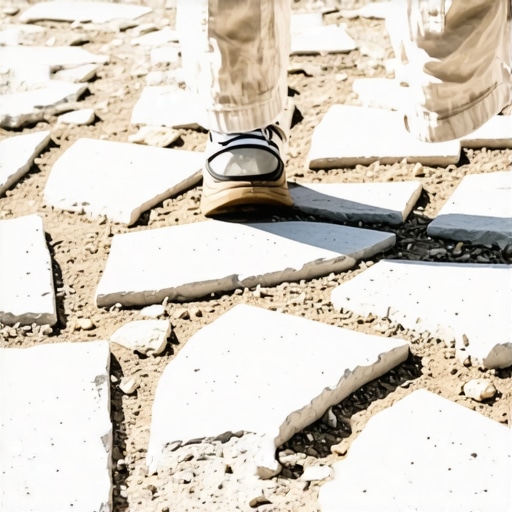
We live in a world of flat, predictable concrete. This environment is the silent killer of proprioception—your body’s ability to sense its position in space. Navigating old age is like a game of Jenga played on a moving subway car. You can have the strongest blocks in the world, but if the foundation is rigid and brittle, the whole tower comes down. Think of your ankle not as a fixed pillar, but as a ship’s keel. A keel that cannot shift with the waves is useless. By relying on flat surfaces and rigid shoes, you have let your ‘keel’ rust. This is why a simple patch of uneven grass feels like a mountain range to a seventy-year-old.
Why are we still pretending that more ‘rest’ is the answer to instability? I’ve discussed how this specific balance exercise is the only thing standing between you and a hospital bed, yet the general public continues to choose the path of least resistance. They choose the orthotic. They choose the cane before they need it. They choose to stop walking on grass. This avoidance behavior creates a feedback loop of fragility. Your ankles become stable when they are challenged, not when they are coddled. You might think you are protecting yourself by staying on the sidewalk, but you are actually guaranteeing a future fall. While you should certainly consider what you need in your bathroom for safety, your primary concern must be the strength you carry within your own tendons. Stop trusting the marketing fluff and start trusting the way your body was designed to move—with tension, awareness, and a refusal to let the terrain dictate your safety.
[image_placeholder]
The Root Cause: Why Support is Actually Sabotage
The footwear industry is built on a fundamental misunderstanding of human anatomy. It is a root-cause error that has crippled a generation. They treat the foot like a flat board that needs to be propped up, rather than a dynamic spring that needs to be loaded. The arch is not a weakness to be filled. It is a structure that gains its strength from the very tension we are told to avoid. By stuffing the void beneath your midfoot with foam, you are effectively putting a kickstand on a bicycle that was designed to lean into the turns. It stops being a vehicle and starts being a prop. You aren’t walking anymore; you are simply managing a collapse.
The Architecture of Weakness
We have been told that ‘fallen arches’ are a medical destiny, a biological breakdown that requires external intervention. This is a fabrication. Most people don’t have broken feet; they have lazy feet. When you wear a rigid orthotic, the small muscles of the foot—the intrinsic stabilizers—completely shut down. They stop firing because they don’t have to. Why would a muscle exert energy when a piece of plastic is doing the work? This atrophy is the hidden engine behind the stability crisis. They promised safety. They gave us a cage. Over time, this reliance on external bracing travels up the kinetic chain, turning a stiff ankle into a weak knee and, eventually, a fragile hip.
${PostImagePlaceholdersEnum.ImagePlaceholderB}
The False Safety of the Flat World
Consider the staggering growth of the global orthotics market, currently valued in the billions. If these devices actually worked to improve balance, we would see a correlating drop in geriatric fall rates. We don’t. In fact, fall-related injuries are skyrocketing. The 30% rise in fall-related hospitalizations among seniors isn’t just a statistical blip; it is an indictment of the ‘support’ culture. We are spending more money than ever to ‘stabilize’ our seniors, yet they are falling more often. This discrepancy exists because we have traded genuine neurological feedback for the illusion of comfort. You cannot buy balance at a pharmacy.
The problem is further compounded by the surfaces we choose to traverse. Every time you opt for the flat, level sidewalk over the uneven dirt path, you are signing a contract for future frailty. Your brain requires ‘noise’—the varied, unpredictable signals from stones, roots, and inclines—to keep its balance software updated. Without this noise, the software glitches. It becomes slow. By the time you hit seventy, your brain’s ability to process a trip or a stumble has been dulled by decades of sensory deprivation. You are walking on a map that hasn’t been updated in forty years. The result is a total system failure at the exact moment you need it most.
It is easy to see why the medical establishment and the podiatry industrial complex have doubled down on the orthotic as the primary solution for the aging foot. The argument they make is compelling: why suffer? If the foot is structurally failing, if the ligaments are lax and the bones are shifting, why not provide a scaffold? This logic is seductive because it works in the short term. It offers immediate relief to the person who can barely stand in the morning. If you are in pain, the promise of a cushioned, structured environment for your feet sounds less like a luxury and more like a human right.
I used to believe this too, until I realized that we were treating the human body like a decaying building rather than a living organism. When a building’s foundation cracks, you shore it up with steel beams because the concrete cannot heal itself. But the human foot is not concrete. It is a complex system of twenty-six bones and dozens of muscles that require stress to maintain their integrity. By providing that ‘scaffold,’ we aren’t just supporting the foot; we are essentially putting it in a cast. And what happens to an arm when it stays in a cast for six months? It withers. It becomes a useless, spindly limb that can no longer perform its basic functions. This is exactly what we are doing to the senior population, one ‘comfort’ shoe at a time.
The False Promise of Structural Support
The critics will argue that for certain conditions—severe hallux valgus or extreme diabetic neuropathy—the risk of walking ‘unsupported’ is too high. They point to the danger of ulcers or further deformity. They aren’t entirely wrong. There is a small percentage of the population where surgical or mechanical intervention is the only path forward. However, we have taken these extreme cases and used them as a template for the general public. We have pathologized the normal aging process to sell a billion-dollar solution that actually accelerates the problem it claims to solve.
${PostImagePlaceholdersEnum.ImagePlaceholderC}
The real danger is that these devices create a false sense of security while simultaneously eroding the very reflexes that prevent a fall. When you are strapped into a rigid orthotic, your brain loses the ability to feel the micro-adjustments of the ground. It stops ‘talking’ to the feet. You might feel more stable in the moment because the shoe is doing the balancing for you, but you are becoming neurologically illiterate. You are losing the vocabulary of movement.
This is the elephant in the room that the shoe companies won’t discuss: the more ‘support’ you buy, the more you will eventually need. It is a dependency model. We are creating a generation of people who cannot walk across their own bedroom in the middle of the night without putting on their ‘special shoes’ because their feet have become so weak and desensitized that they can no longer function on their own. We have traded our biological autonomy for a bit of foam and plastic, and the cost is being paid in broken hips and lost independence. If we want to fix the fall crisis, we have to stop asking how to support the foot and start asking how to wake it up.
We are currently witnessing the birth of a mechanical dependency that rivals the most pervasive medical crises of our time. When we tell a sixty-year-old that they need a custom insert just to walk across their kitchen, we aren’t providing healthcare; we are issuing a life sentence of fragility. This is the slippery slope that ends not with a better gait, but with a total surrender of mobility. If you follow this path to its logical conclusion, you see a world where the act of standing upright becomes a subsidized, industrial process rather than a human right.
In five years, if we do not break this cycle, the ‘fall prevention’ industry will be a multi-trillion dollar behemoth that thrives on the very disasters it fails to prevent. We will see assisted living facilities filled with people whose only crime was believing a marketing brochure. The stakes are nothing less than the final decades of your life. Do you want to spend them navigating the world on your own terms, or do you want to be a passenger in a body that has forgotten how to interact with the earth?
Is it too late to change course?
The analogy I often use is that of an astronaut returning to Earth after months in orbit. In the weightless vacuum of space, the body decides that bone density and muscle mass are unnecessary luxuries. Without the constant, unforgiving resistance of gravity, the skeleton softens. When that astronaut lands, their legs can shatter under the weight of their own history. By wrapping our feet in three inches of foam and carbon-fiber plates, we have created a ‘zero-gravity’ environment for our ankles. We are training our bodies for a world that does not exist, and the moment we step off the carpeted path, the bill comes due.
${PostImagePlaceholdersEnum.ImagePlaceholderD}
The Cost of Inaction
Every day you choose the ‘comfort’ of an orthotic over the work of strengthening your arch, you are reinforcing a neurological dead zone. We are sleepwalking into a crisis where the average senior will be functionally immobile by seventy-five, not because of disease, but because of atrophy. This is a moral failure of the highest order. We have prioritized the immediate absence of discomfort over the long-term preservation of capability. We have traded our biological inheritance for a pair of expensive sneakers that treat us like toddlers.
The Point of No Return
We are approaching a threshold where the damage becomes systemic. When the foot dies, the ankle stiffens; when the ankle stiffens, the knee compensates; when the knee fails, the hip bears the brunt of the impact. It is a kinetic domino effect that ends in a surgical suite. The warning is clear: stop treating your feet like problems to be solved and start treating them like the high-performance sensors they are. If we don’t demand a return to biological reality now, we will soon find ourselves living in a society where the simple act of a walk in the park is a memory preserved only in old photographs.
Your Move
The decision to outsource your balance to a piece of foam is the beginning of the end for your independence. Every time you slide that rigid insert into your shoe, you are telling your nervous system to go to sleep. You are opting for a temporary silence that leads to a permanent scream. If you want to avoid the surgical suite, you have to embrace the friction of the real world. This is about more than just footwear; it is about refusing to let your biological hardware rust out of a misplaced desire for comfort. It is time to stop asking what your shoes can do for you and start asking what your feet are still capable of. You might need to learn how to manage a flare up when you first start this transition, but that temporary discomfort is the price of admission for a lifetime of movement.
The Final Verdict
True stability is an earned resource, not a purchased commodity. You cannot buy your way out of atrophy, and you cannot foam-pad your way to a fracture-proof life. The only thing standing between you and a future of total mechanical dependency is your willingness to let the ground challenge you. We’ve seen how personalized telehealth strategies can guide the journey, but they are just maps. You are the one who has to walk the path, and you can’t do it in a cast.
The Twist
The industry wants you to believe your body is a ticking time bomb of structural failures so they can sell you the fuse. But the real explosion happens when you stop moving. The irony is that by making life easier for your feet today, you are making life impossible for your balance tomorrow. While you focus on what every senior should have in their bathroom for safety, you are ignoring the most important safety feature of all: a foot that can feel the floor. [image_placeholder] Take off the training wheels. Step off the sidewalk. Your ankles don’t need a savior; they need a job. Give it to them before they forget how to do it entirely.