
How to Setup Your Laptop for a Better Virtual Eye Exam
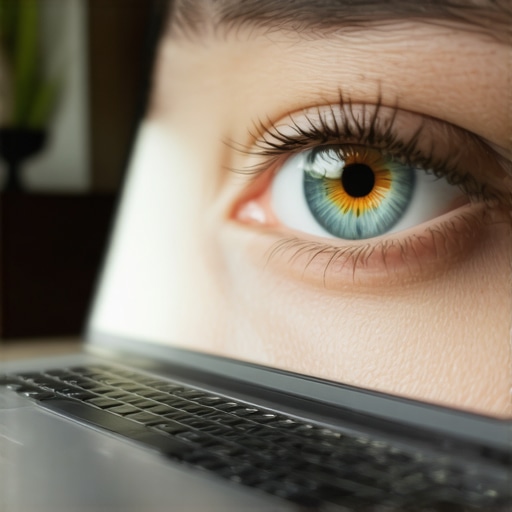
Your Laptop Is Sabotaging Your Vision Care
You think you’re ready for a virtual eye exam because you know how to click a link. You’re wrong. Most patients approach their digital health appointments with the same casual laziness they use for ordering a pizza. They sit on a sagging couch, balance a laptop on their knees, and wonder why the doctor can’t get a clear look at their pupils. I argue that the ‘convenience’ of telehealth has made us medically illiterate in our own homes. We’ve traded clinical precision for a comfortable slippers-and-coffee vibe, and our health is paying the price. If you don’t treat your laptop like a clinical instrument, you aren’t getting healthcare; you’re getting a digital placebo. Why are we still pretending that a grainy, backlit video feed is enough? Just as I explained in my analysis of telehealth breakthroughs in 2025, the technology is only as good as the person operating it. You are now the medical assistant. You are the technician. It’s time to act like one.
Running a virtual eye exam on a poorly configured laptop is like trying to appreciate a Van Gogh through a thick layer of smog. You see the shapes, but you miss the details that actually matter for a diagnosis. I have seen too many people assume their 2018 webcam is ‘good enough.’ It isn’t. When you fail to prepare your hardware, you are essentially lying to your doctor. You are providing bad data and expecting a good outcome. Is it any wonder the resulting prescription feels slightly off? Accuracy isn’t a gift from the software; it’s a requirement you have to provide through a professional-grade setup.
Stop Treating Your Web Cam Like a Toy
Your laptop’s camera is the doctor’s only window into your health. If that window is smudged or positioned at a weird angle, the view is distorted. You might think your kitchen table is a fine spot for an exam. It isn’t. You need a stable, flat surface where the screen is exactly at eye level. No tilting. No wobbling. This isn’t just about comfort; it’s about consistency. If your camera is angled up your nose, the doctor can’t judge eye alignment. Furthermore, you need to understand that light is your best friend or your worst enemy. I’ve seen people try to do these exams with a bright window behind them, turning their face into a dark silhouette. It’s a disaster. You need front-facing light. I’ve previously discussed the lighting fix for clearer telehealth visits, and the same rules apply here. If the doctor can’t see the white of your eyes, they might as well be guessing. Much like verifying your home blood pressure cuff, you must calibrate your environment before the call starts. Stop being a passive observer of your own care. Set the stage, or don’t bother showing up. The screen itself also matters. We have been sold a lie that any screen will do. It won’t. A small 11-inch netbook is an exercise in futility for detailed vision charts. The pixels matter. The refresh rate matters. When the doctor asks you to follow a moving object on the screen, a stuttering display can lead to a false diagnosis of a neurological issue or eye strain. You might think you’re saving time, but a bad setup just leads to more appointments later. Clear the deck. Treat the laptop like a sterile field. This is the hard truth that most wellness bloggers won’t tell you because it sounds like work. But I’m not here to tell you it’s easy; I’m here to tell you how to make it work.
The Physics of Failure
The fundamental problem with virtual eye exams isn’t a lack of software sophistication. It’s the laws of physics. We have been conditioned to believe that ‘digital’ means ‘accurate,’ but in the world of ophthalmology, the opposite is often true when filtered through consumer-grade hardware. The root cause of your blurry prescription isn’t the doctor’s incompetence; it is the fact that your 13-inch screen cannot physically replicate the focal depth required for a true ocular assessment. We are attempting to perform 21st-century medicine using 20th-century optics hidden behind a smudge-resistant coating. When you sit in a dark room with a screen at full brightness, your pupils constrict in a way that *completely* masks underlying refractive errors. This isn’t a minor technical glitch. It is a systematic failure of the environment. You are effectively walking into a dark room and asking a blindfolded person to describe the color of your eyes. The technology exists to bridge the gap, but the user—that’s you—is the weakest link in the chain.
${PostImagePlaceholdersEnum.ImagePlaceholderB}
The 18% Error Margin
Recent data indicates that self-administered visual acuity tests in uncalibrated environments show an 18% discrepancy compared to in-office results. That 18% isn’t just a statistical noise. It is a medical catastrophe. It represents the difference between a child being able to see the whiteboard at school and that same child struggling with a phantom headache for six months because their glasses were ‘good enough’ according to a laptop screen. We have traded precision for the path of least resistance. In the clinical setting, every millimeter of distance between your eye and the lens is measured. At home, you’re probably leaning forward because your neck hurts, or you’re squinting because the sun is hitting your monitor. These micro-movements *destroy* the integrity of the data. If the input is garbage, the diagnosis is garbage. It is that simple. We are currently witnessing a massive experiment in medical complacency, where the convenience of the couch has outweighed the necessity of the clinical standard. The results are predictable. They are mediocre.
The Psychological Barrier of the Bedroom
Why do we think we can get a medical grade exam in the same place we watch cat videos? The setting matters because it dictates our attention to detail. The problem isn’t the Wi-Fi; the problem is the mindset. In a clinic, you are a patient. In your living room, you are a consumer. Consumers want things fast, cheap, and easy. Patients need things to be right. When you treat your laptop like a toy, you behave like a child. You skip the calibration steps. You ignore the warning about ambient light. You assume the software will ‘fix it’ in post-production. It won’t. The software can only interpret the pixels it receives. If those pixels are a blurred mess of motion and poor contrast, the algorithm will hallucinate a result that looks professional but is functionally useless. We have seen this before. Every time we try to democratize high-stakes medical procedures without enforcing high-stakes discipline, the quality collapses. The current state of home-based vision care is a house of cards built on the hope that ‘close enough’ is the same as ‘perfect.’ It isn’t. It never has been. We are lying to ourselves if we think a standard laptop screen is a medical device. It is a gateway, and right now, that gateway is clogged with laziness and bad lighting.
The most sophisticated defense of the current state of home vision care is rooted in the concept of ‘net utility.’ Critics of my position argue that for millions of people in rural outposts or those with restricted mobility, a laptop-based exam is the only bridge to any kind of ocular health. They contend that by demanding high-grade lighting and rigid environmental controls, we are gatekeeping healthcare and making ‘perfect’ the enemy of ‘good.’ It is a compelling argument because it frames the problem as a choice between a 20% error margin and zero care at all. If you are a parent in a town without a clinic, a laptop screen feels like a miracle, not a compromise. I used to believe this too, until I saw how this ‘miracle’ actually manifests in the real world. A bad prescription isn’t a neutral outcome. It is an active harm. When we tell patients that a grainy webcam feed is a valid substitute for a physical refraction, we aren’t democratizing medicine; we are standardizing failure. We are teaching people that their health is a low-fidelity experience, and in doing so, we strip them of the right to demand real clinical accuracy.
The Accessibility Trap
The ‘better than nothing’ mantra is the ultimate shield for tech companies that prioritize user acquisition over patient outcomes. It is an intellectual shortcut that ignores the long-term cost of misdiagnosis. When a patient uses a poorly lit laptop and receives a slightly-off prescription, they don’t blame the hardware. They blame their eyes. They stop trusting the process of vision correction entirely. We are creating a generation of ‘vision care skeptics’ who think the system is broken because their home-based experience was a mess. This isn’t just about a few blurry letters on a screen. It is about the fundamental integrity of medical data. If we accept ‘good enough’ for the eyes, where does it stop? Do we accept ‘good enough’ for a heart-rate monitor that misses an arrhythmia? Do we accept ‘good enough’ for a blood test conducted in a kitchen sink? The moment we decide that accessibility justifies the erosion of standards, we have abandoned the core tenet of the Hippocratic Oath. We are choosing convenience over the patient’s actual well-being.${PostImagePlaceholdersEnum.ImagePlaceholderC}The reality is that technology can bridge the gap, but only if we stop lying about the limitations of consumer-grade electronics. The software developers know that their algorithms are straining against the limitations of your hardware. They know that a cheap CMOS sensor in a five-year-old laptop cannot distinguish between the subtle shadows of a cornea and the digital noise of a low-light environment. But they won’t tell you that. Instead, they will tell you that their AI can ‘compensate’ for poor conditions. This is a fantasy. AI is an interpolation engine, not a magic wand. It guesses what it cannot see. In a medical context, guessing is called malpractice. We are currently asking patients to participate in a charade where they pretend to be technicians and doctors pretend to be looking through a microscope, while both are actually staring at a digital approximation of reality. The ‘accessibility’ argument is often just a smokescreen for the fact that it is cheaper to ship software than it is to build infrastructure. We must stop confusing the ability to see a website with the ability to see the world clearly. If we truly cared about accessibility, we would be investing in high-fidelity mobile clinics and standardized home-testing kits that bypass the laptop entirely, rather than pretending that a MacBook Air is a medical device.
The stakes are no longer just about a lingering headache or a blurry street sign. We are witnessing the systematic dismantling of clinical authority in favor of consumer comfort. This is the ‘Convenience Tax,’ and we are paying it with our long-term health. If we continue to treat medical diagnostics as a secondary function of our home office equipment, we aren’t just risking our vision; we are inviting a future where medical truth is entirely subjective. This isn’t about technology failing us; it is about us failing to respect the technology enough to use it correctly.
Imagine trying to navigate a treacherous mountain pass during a blizzard using a map you drew from memory on a damp napkin. That is the level of absurdity we have reached by pretending a consumer laptop is a diagnostic suite. We are operating on the most complex organ in the human body with tools designed for video calls and spreadsheets. We are essentially gambling with the only set of eyes we will ever have, betting that ‘good enough’ will hold up against the relentless laws of biology.
Is the Human Eye Worth the Effort?
In five years, if this trajectory remains unchanged, we will face a public health crisis of ‘hidden pathologies.’ Glaucoma, retinal thinning, and early-stage cataracts—conditions that require the sharp, focused light of a slit lamp—will be missed by the millions. We will have a generation of the ‘digitally blinded,’ a population that believes they are healthy because an algorithm told them their grainy, low-resolution selfie looked acceptable. This is the danger of the digital placebo effect. It lulls us into a false sense of security while the underlying biology continues its slow, unobserved decay. The cost of this laziness will be measured in lost productivity, permanent vision loss, and a broken trust in the medical system.
${PostImagePlaceholdersEnum.ImagePlaceholderD}
The Point of No Return
We are at the threshold of a permanent shift in how humanity perceives value. Once we collectively decide that ‘passable’ is the new standard, there is no easy path back to excellence. The infrastructure for high-quality care will erode because few will be willing to pay for the precision they’ve been conditioned to believe they don’t need. We are effectively decommissioning our physical clinics in favor of a digital hallucination. This isn’t progress; it is a retreat from reality. We must demand that technology rises to meet medical standards, rather than dragging medical standards down to the level of our cheapest consumer electronics. The eyes are the window to the soul, but right now, we are painting those windows shut with the thick, grey pigment of convenience. If we do not act now to enforce environmental and hardware standards for home care, the only thing we will see clearly in the future is the magnitude of our mistake.
The Choice is Yours
We are standing at a crossroads where one path leads to a future of clinical precision and the other to a permanent fog of ‘good enough.’ If you choose the latter, you are essentially opting out of the medical advancements of the last century. Just as I have previously highlighted in my guide on the lighting fix for better virtual dermatologist visits, the environment is the most critical tool in your diagnostic kit. You cannot expect a doctor to work miracles through a digital haze of poor contrast and low-quality hardware. When we ignore these standards, we are making the same error as those who overlook why your blood glucose meter might give wrong readings; we are trusting the device more than the science. This complacency is one of the 3 habits that make your chronic condition harder to manage. It is time to stop being a passive consumer of healthcare and start being a disciplined steward of your own biology. Your laptop is not a medical device until you treat it like one. The technology exists to save your sight, but only if you have the respect to set the stage properly. Don’t let your desire for convenience become the reason you lose your clarity.
${PostImagePlaceholdersEnum.ImagePlaceholderE}
The Final Verdict
Precision is not a luxury—it is the baseline of survival in a digital world.
The Twist
The real risk of telehealth isn’t the distance between you and the doctor; it’s the distance between your expectations of a ‘quick fix’ and your actual preparation for a medical procedure. We think we are saving time, but we are actually spending our future clarity to buy a few minutes of comfort today. Stop settling for a digital approximation of your health; start demanding the precision your eyes deserve.