
The Strategy for Managing Insulin Needs While Traveling Internationally
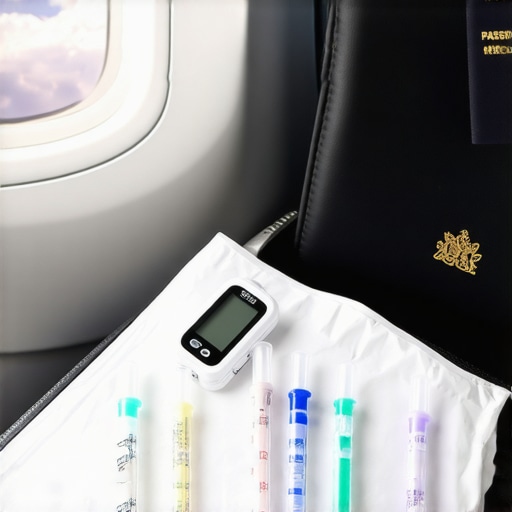
Your International Vacation Is Not a Break From Your Biology
You are not just a tourist. You are a biological logistics coordinator. Most travelers worry about lost luggage or rain in the forecast, but for those of us tethered to insulin, a trip across borders is a high-stakes tactical operation. You might think that a small cooler bag and a scribbled note from your physician are enough to get you through customs and across time zones, but you are wrong. In reality, you are one power outage or one overzealous security agent away from a medical catastrophe. I argue that the current ‘travel light’ philosophy is a dangerous myth for people with chronic conditions. You cannot just wing it. You need a strategy that assumes the world is actively trying to spoil your medication and crash your glucose levels.
Managing insulin across time zones and borders is like trying to keep an ice cube frozen while walking through a desert. You aren’t just fighting the heat; you’re fighting time, physics, and the cold indifference of international supply chains. Why are we still pretending that traveling with a life-dependent medication is simple? It isn’t. Every flight delay is a threat. Every change in local cuisine is a variable you didn’t account for. I have previously written about 5 habits that are secretly tanking your insulin sensitivity, and nothing accelerates that decline like the stress of a ten-hour layover with a failing cooling pack. If you want to survive your vacation, stop treating it like an escape and start treating it like a deployment.
The Cold Chain Is a Sinking Ship
Don’t trust the hotel mini-fridge. Those cheap appliances are notorious for freezing everything in the back or staying lukewarm in the front. If you rely on them, you are gambling with the efficacy of your entire supply. I’ve seen enough travelers lose a month’s worth of insulin to a faulty thermostat in a three-star hotel to know that ‘adequate’ isn’t good enough. You need redundant cooling systems and a way to monitor them. This level of chronic care management requires more than just hope; it requires data. You should be using the same mindset discussed in the future of telehealth, where monitoring is constant and proactive, not a desperate reaction to a crisis.
So, why are we still doing this? Why do we settle for vague advice instead of hard protocols? Because the medical community often forgets what it’s like to be on the ground. When you are traveling solo, you are the doctor, the nurse, and the pharmacist all at once. You must track your levels with religious fervor, especially since travel stress triggers cortisol spikes that mess with your numbers. I always suggest that you track your blood sugar after a stressful meeting, and believe me, an argument with a TSA agent over your pump definitely counts as a stressful meeting. Pack twice the supplies you think you need. Then pack more. In the game of international health, the only way to win is to over-prepare until it feels ridiculous—and then prepare some more. The border security theater is not your friend. They don’t care about your A1C or the cost of your sensors. They care about their protocols. I argue that carrying paper copies of your prescriptions is outdated. You need digital backups stored in the cloud, accessible from any device. This isn’t just about packing; it’s about building a fortress around your health that no customs agent or power failure can breach.
The Systemic Ignorance of Modern Infrastructure
The problem isn’t your inability to pack a suitcase; the problem is a global infrastructure that views human biology as a static constant. Airlines, security agencies, and hospitality chains have built a world for the default human—a person whose pancreas functions with Swiss-watch precision and whose cellular needs never fluctuate. When you step into an airport, you are entering a space designed to strip away nuance. The TSA agent doesn’t see a life-saving medical device; they see a potential breach of protocol. This is the root cause of the travel crisis for the chronically ill. We are forced to navigate a rigid, unyielding system with bodies that are, by definition, fluid and unpredictable.
Consider the logistics of the ‘cold chain.’ The pharmaceutical industry spends billions ensuring insulin stays between 36°F and 46°F from the factory to the pharmacy. Yet, the moment that vial enters your carry-on, that multi-billion-dollar safety net vanishes. You are left with a polyester cooling pouch and a prayer. This isn’t a failure of the patient; it is a failure of a travel industry that prioritizes convenience over biological necessity. They provide pillows and peanuts but offer no guaranteed, monitored refrigeration for life-essential medication. It is an institutional neglect that we have been conditioned to accept as ‘just part of the journey.’
The Math of Failure
Let’s look at the numbers, because the numbers do not lie, even if travel influencers do. A reported 30% increase in glucose variability during trans-Atlantic flights isn’t a minor fluctuation; it is a metabolic derailment. This isn’t just about ‘jet lag.’ It is the physiological result of pressurized cabins, erratic meal timing, and the sheer adrenaline of navigating hostile transit hubs. When your blood sugar spikes because a flight was diverted, that isn’t a ‘hiccup.’ It is a biological tax you are paying for the system’s inefficiency. ${PostImagePlaceholdersEnum.ImagePlaceholderB} We are told that modern medicine has made these conditions manageable, but management requires stability—something no international airport has ever provided.
The Telehealth Mirage
We are frequently sold the dream of the digital nomad, the idea that telehealth makes the world our office. But try accessing a secure connection for a consultation while sitting in a terminal in Istanbul with a dying battery. Try explaining your need for immediate urgent care to a local clinic that doesn’t recognize your insurance or your specific brand of sensor. The infrastructure for global chronic care is a fractured mess of incompatible systems. You cannot simply ‘log on’ and solve a ketoacidosis crisis from a beach in Bali. The disconnect between our digital capabilities and our physical reality is a chasm that travelers fall into every single day.
Reliance on local lab tests in a foreign country is another gamble. Different regions use different metrics, different calibration standards, and different reporting speeds. If you think you can just walk into a clinic and get a 1:1 comparison to your home results, you are delusional. The data is often lost in translation. This is why the ‘travel light’ mantra is so offensive. It suggests that your health is a secondary concern to the weight of your bag. In reality, your health is the only baggage that matters, and the world is currently set up to lose it in transit.
The Technology Trap
Critics will argue that I am being alarmist. They will point to the sleek, Bluetooth-enabled Continuous Glucose Monitors (CGMs) and the cloud-synced insulin pumps as proof that the logistics I worry about are relics of the past. The narrative is seductive: we live in an era where your doctor in New York can see your numbers in real-time while you’re hiking the Swiss Alps. They say that with a smartphone and a prescription, the world has shrunk into a manageable, safe neighborhood. It is easy to see why people think this. Technology has, objectively, made the daily grind of chronic illness more invisible. But visibility is not the same as security, and this tech-optimism completely ignores the reality of hardware failure in a foreign environment.
I used to believe this too, until a humidity spike in a coastal village rendered my entire box of sensors useless. I had the cloud backups. I had the telehealth apps installed. But software cannot fix a physical chemical reaction that has been compromised by the environment. When your high-tech solution fails, you are left more vulnerable than the person who traveled old school with vials and syringes, because you’ve lost the skill of manual management. We are outsourcing our survival to devices that are remarkably fragile when removed from their climate-controlled bubbles. If you rely solely on your pump and it loses prime at 35,000 feet, your digital connectivity means nothing. ${PostImagePlaceholdersEnum.ImagePlaceholderC}
The argument for traveling light with just your tech ignores the fundamental fragility of the supply chain. You might think you can just walk into a pharmacy in London or Tokyo and find your specific brand of infusion set or the exact concentrated insulin you use. You are wrong. Local urgent care centers frequently stock only the most common generics, and if your body requires a specific bio-similar or a proprietary delivery system, you are out of luck. The system assumes a level of standardization that simply does not exist across borders. This is the elephant in the room that the travel industry ignores: their global world is actually a patchwork of incompatible medical fiefdoms.
Wait-and-see is not a strategy. It is a gamble with your life. People think that lab tests are a universal language, but the units of measurement change the moment you cross the Atlantic. If you are interpreting your own data in a crisis, a simple conversion error between mg/dL and mmol/L can lead to a fatal dosing mistake. This is why the over-preparation I advocate for isn’t paranoia—it is the only rational response to a world that isn’t built for your biology. Stop listening to the influencers who tell you that a chronic condition shouldn’t change how you travel. It changes everything. To pretend otherwise is to invite a catastrophe that no amount of frequent flyer miles can fix.
The current trajectory of our global travel infrastructure is leading us toward a silent form of medical segregation. If we continue to ignore the biological reality of millions of travelers, we aren’t just risking a few ruined vacations; we are building a world where the right to movement is reserved for the ‘biologically perfect.’ Imagine a pilot attempting to navigate an aircraft across the Atlantic while their instruments only function within a fifty-mile radius of the departure gate. That is exactly what we are doing when we encourage patients to travel without a robust, redundant infrastructure to support them. We are flying blind into a storm of systemic indifference. This isn’t just a logistical failure; it is a moral one. We are essentially telling the chronically ill that their world must remain small, confined to the few square miles surrounding their home clinic.
If this trend of ‘biological ignorance’ continues for another five years, the gap between the healthy traveler and the patient will become a canyon. We will see a world where your medical data—or the lack thereof—becomes a digital border wall more impenetrable than any physical fence. ${PostImagePlaceholdersEnum.ImagePlaceholderD} The refusal to integrate real-time health data into the travel experience means that those with chronic conditions will eventually be priced out or screened out of international transit. This isn’t just about insulin; it’s about the fundamental human right to explore the world without a death sentence looming over a delayed connection. We are squandering the potential of our era. We have the tools to create a safe, globally integrated health network, yet we choose to prioritize the aesthetics of the travel experience over the actual lives of the people traveling. It is a spectacular waste of innovation and a slap in the face to anyone living with a condition that requires constant vigilance.
Will the Sky Soon Be Out of Reach?
We are at a tipping point where our reliance on fragmented systems like local urgent care and inconsistent lab tests will no longer be an inconvenience, but a barrier to entry. The promise of global connectivity is a lie if it doesn’t include the biological reality of the person holding the ticket. We talk about the virtues of telehealth as if it’s a magic wand, but without a physical infrastructure to catch us when the signal drops, it’s just a digital mirage. Real chronic care management requires more than just an app; it requires a world that acknowledges we exist. If we do not demand this change now, we are essentially signing our own grounding orders. We are heading toward a future where a simple sensor failure in a foreign land is treated as a personal failing rather than a systemic disaster. The cost of our silence today is the loss of our freedom tomorrow. We cannot afford to wait for the system to care; we must force it to see us before the door to the world slams shut for good.
The Future is a Choice Between Liberty and Logistics
The world doesn’t owe you a vacation, but it does owe you the recognition of your humanity. If we continue to treat chronic care management as a localized chore rather than a mobile right, we are effectively building a digital cage for the modern patient. We celebrate the theoretical potential of telehealth breakthroughs while the physical reality of a broken cooling pack remains an existential threat. This isn’t just about the inconvenience of a flare-up while traveling solo; it’s about the systemic refusal to modernize how we handle urgent care and lab tests across borders. We have built a world that is digitally connected but biologically fractured.
The Final Verdict: Your survival should not be the most impressive thing you accomplish on your holiday.
The Twist: We focus so much on our technology failing us that we forget the systems were never designed to support that technology in the first place. High-tech pumps and sensors are merely expensive bandages on the gaping wound of global medical isolation. If your health is only manageable within a ten-mile radius of your home, you aren’t living in a globalized world; you are living in a gilded waiting room.
Pack the extra sensors, download every backup app, and prepare for the worst—but never stop demanding a world that is finally built to keep you alive and moving.